Blog - The latest articles and news
Stay up-to-date with the latest industry news as our marketing teams finds new ways to re-purpose old CSS tricks articles.
Stay up-to-date with the latest industry news as our marketing teams finds new ways to re-purpose old CSS tricks articles.
by Kingdom Kode Team, Digital Innovation

You spent three weeks on the deck. The font is perfect. The story flows. Then a partner says "send us access to your data room," and you realize you don't have one — you have a Google Drive folder with a pitch PDF and a spreadsheet you'd be embarrassed to share. That moment is when most early founders discover they never asked the real question: what do investors want to see before investing — beyond the story you tell in the room?
That gap is where rounds die. The deck gets you the meeting. The data room gets you the check. And most founders don't know the difference until diligence exposes it.
So let's answer it directly, with proof instead of adjectives.
A deck is a pitch. A data room is evidence. Investors have heard a thousand pitches. What separates a term sheet from a polite pass is whether the numbers, the tech, and the operations behind the pitch hold up when someone actually looks.

Here's the uncomfortable truth: diligence isn't checking if your idea is good. It's checking if you're a risk. Every messy spreadsheet, every metric you can't source, every "we'll build that later" system is a reason to lower the valuation or walk.
Capital readiness isn't something you scramble to assemble during a raise. It's something you engineer before you ever open a round.
Strip away the theater and investor diligence comes down to four questions. Answer them with proof, not adjectives.
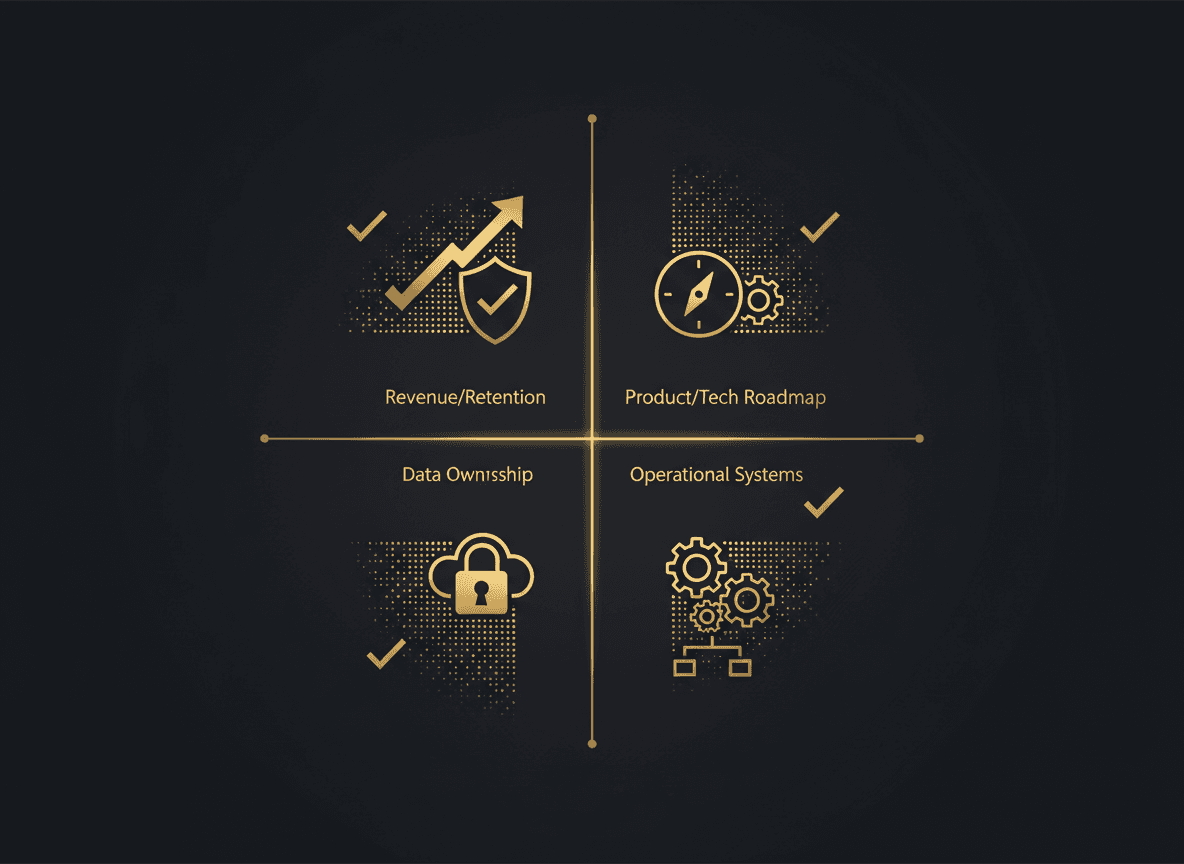
Investors don't just want to see revenue. They want to see revenue they can trust to three decimal places.
That means:
If you can't produce these in an afternoon, that's not a data room problem. That's an instrumentation problem. You never built the systems that track the numbers investors ask for.
Investors want to see that you can turn their money into product on a predictable schedule. A roadmap of 40 features with no priority and no engineering reality behind it signals the opposite.
What reads as fundable:
Here's a question that ends rounds quietly: "Who owns your data and your codebase?"
If your product runs on a no-code tool you don't control, your customer data lives in a third-party platform you can't export cleanly, or your entire backend is one contractor's undocumented account — you don't own an asset. You own a liability with a monthly subscription.
Investors are buying equity in a defensible thing. They check:
Defensibility isn't a slide. It's an architecture decision you made months ago.
Can the business operate without you manually holding it together? Investors look for documented processes, systems that talk to each other, and the absence of a founder who is personally the integration layer between six tools.
A stack held together with Zapier, manual CSV exports, and a founder copy-pasting between apps at midnight tells an investor exactly one thing: this doesn't scale, and their money will be spent fixing plumbing instead of growing.

Every manual workaround is a future failure point. Every disconnected tool is a place where the numbers can drift and stop reconciling. When diligence hits a duct-taped stack, the questions get sharper and the valuation gets softer.
The founders who raise well aren't the ones with the flashiest deck. They're the ones whose operations are boring in the best way — clean, connected, documented, owned.
Here's the reframe that changes everything: the data room isn't paperwork you generate at the end. It's the natural output of a business that was built to be measurable and defensible from the start.
If your systems produce clean numbers, own your data, and run without heroics, the data room assembles itself. If they don't, no amount of last-minute cleanup hides it — diligence is designed to find exactly the gaps you papered over.
This is the whole idea behind how we build with founders in Zero-to-Hero and EdenKode: you engineer the operational and technical evidence first, so "fundable" is a byproduct of how the company runs — not a costume you put on for a raise.
Before you build a data room, find out what's actually missing. Most founders are one or two systems away from readiness and don't know which two.
Run your free Revenue Code Diagnostic — it pinpoints the gaps in your metrics, tech, and operations that investors will scrutinize, so you fix them before diligence does it for you.
Already know you need the systems built and want to move fast? Apply to Zero-to-Hero or book a pricing call. And if you want more on building fundable infrastructure, the rest of the blog goes deeper.
Most SaaS founders treat the free trial as a waiting room. The ones converting at 25% or higher treat it as a structured sales system. Here is how to build that system.
Read moreA product roadmap tells you what you are building. A revenue engine tells you whether it is making money. Most SaaS founders only have one of these, and it is the wrong one.
Read more