Blog - The latest articles and news
Stay up-to-date with the latest industry news as our marketing teams finds new ways to re-purpose old CSS tricks articles.
Stay up-to-date with the latest industry news as our marketing teams finds new ways to re-purpose old CSS tricks articles.
by Kingdom Kode Team, Digital Innovation

You take bookings and you take payments, but without an integrated payments and booking system the two never talk to each other — and that gap is quietly draining your cash flow.
Here's the scene. A customer books a Saturday slot on Calendly. No card required. Saturday comes, they ghost. You're out the chair, the hour, and the revenue. If you'd captured a $25 deposit at booking, a no-show costs them, not you. But your booking tool doesn't take money, so you don't ask. That problem repeats every single week.
Most SMB owners running restaurants, home services, and spas have three tools duct-taped together: Calendly for scheduling, Stripe or Square for payments, and a spreadsheet or QuickBooks to make sense of it. None of them share a record. So money slips through the cracks between them.
When your booking tool and your payment tool are separate, every transaction requires a human to connect the dots. And humans forget, fat-finger, and get busy on the third callback of the morning.
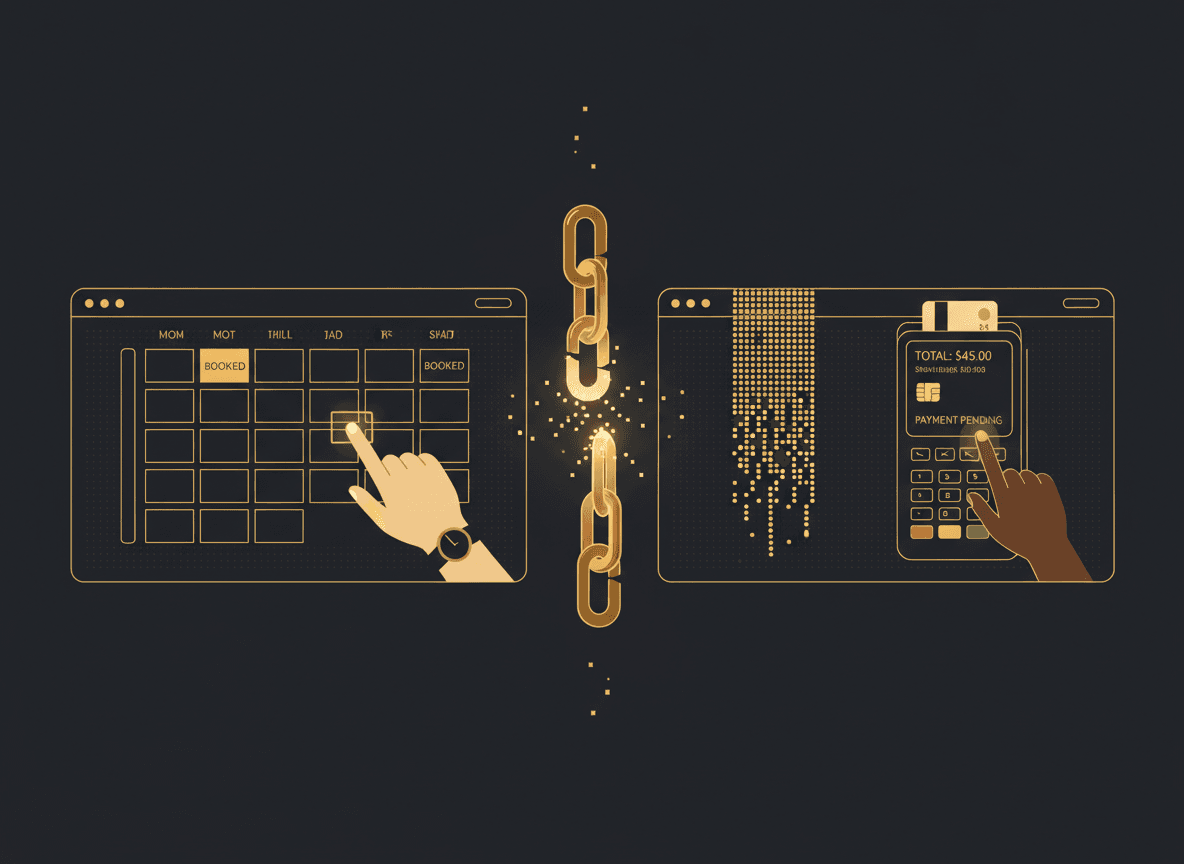
The booking says one thing. The payment processor says another. Nobody's sure who paid, who owes, and who booked but never got charged. That uncertainty is the leak.
Here are the four places it happens.
No deposit at booking means no skin in the game. Take a hypothetical med spa doing 80 appointments a month with a 15% no-show rate — that's 12 empty slots. At $120 a slot, that's $1,440 a month walking out the door — money a $30 deposit-at-booking rule would have protected. The numbers are illustrative, but the pattern is real.
Job's done. Now someone has to remember to send the invoice, then chase it. Home services owners know the drill: the work is finished, but the cash sits in "I'll send it tonight" limbo for two weeks. Cash you earned that you can't spend.
End of month, you're matching Square deposits against your booking calendar against your bank statement. Three sources, none aligned. You either overpay your bookkeeper to untangle it or you accept that a few hundred dollars a month is "just missing." Both cost you.
When payment happens on a separate device after the service, you lose the moment. The add-on treatment, the retail product, the tip prompt — all gone because checkout isn't tied to the booking. Picture a salon that adds a one-tap 18/20/22% tip prompt at checkout: it doesn't "ask" for tips; the system does.
The fix is one system of record where the booking and the money are the same object.
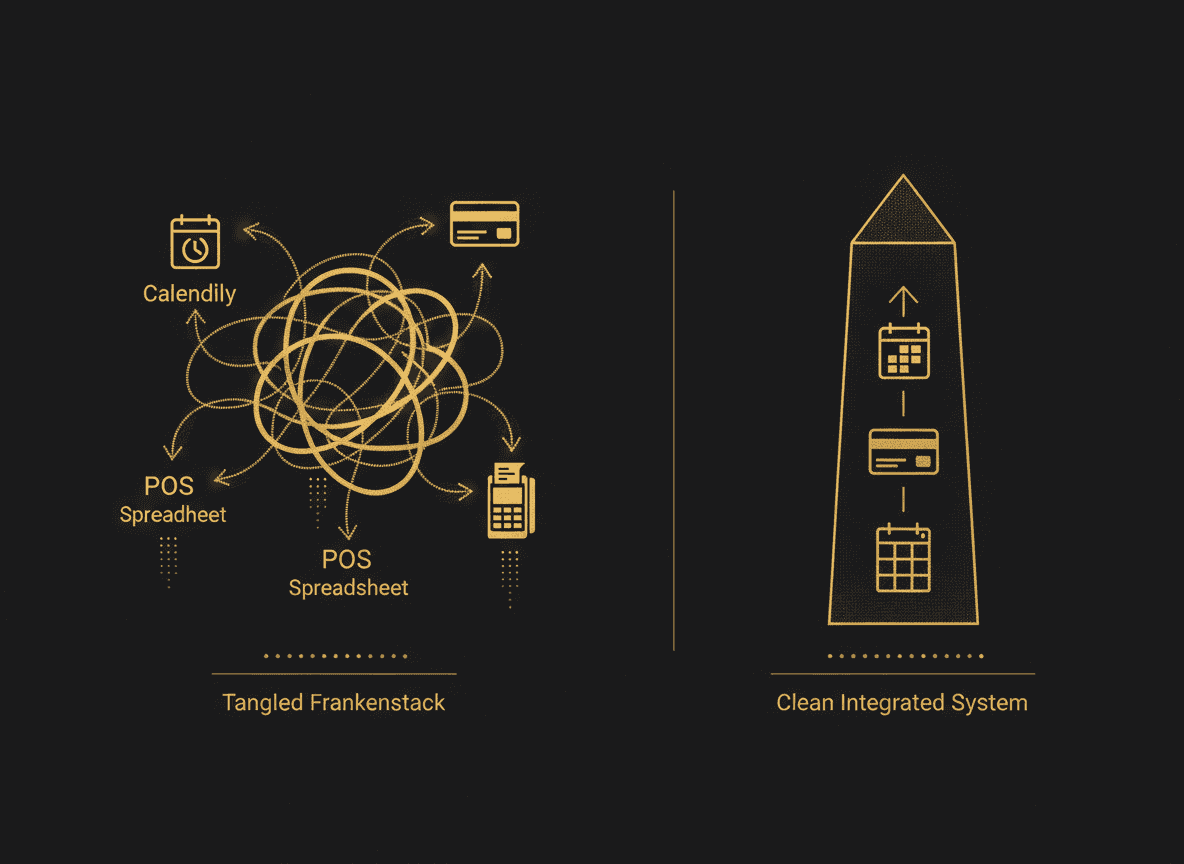
When a customer books, the card is captured. The deposit posts against the appointment. When the service is done, the balance charges automatically, the tip prompt fires, the receipt sends itself. Every dollar is stamped to a booking. Reconciliation stops being a monthly ritual because there's nothing to reconcile — the record already matches.
Concretely, integrated means:
You stop being the human glue between three apps.
Running Calendly + Stripe + a POS + a spreadsheet feels cheap because each tool is $15–$70 a month. But the real cost isn't the subscriptions. It's the leakage and the labor.

Add it up for a hypothetical home services business doing $40k/mo:
That's the frankenstack tax. You're not paying it in one line item, so you never see it. But it's real, and it's monthly.
You don't need software to find the holes. Do this:
Most owners are shocked. The leak was invisible because it was spread across four tools that don't talk.
Bookings without payments is a cash flow problem wearing a scheduling costume. When the booking and the money live in one record, deposits get captured, balances get charged, tips get prompted, and reconciliation disappears.
Want to know exactly where your revenue is leaking and what it's costing you? Run your free Revenue Code Diagnostic — we'll map your booking-to-payment gaps and show you the number you're leaving on the table.
Prefer to talk it through first? Book a pricing call.
Most SaaS founders treat the free trial as a waiting room. The ones converting at 25% or higher treat it as a structured sales system. Here is how to build that system.
Read moreA product roadmap tells you what you are building. A revenue engine tells you whether it is making money. Most SaaS founders only have one of these, and it is the wrong one.
Read more