Blog - The latest articles and news
Stay up-to-date with the latest industry news as our marketing teams finds new ways to re-purpose old CSS tricks articles.
Stay up-to-date with the latest industry news as our marketing teams finds new ways to re-purpose old CSS tricks articles.
by Kingdom Kode Team, Digital Innovation

Every day someone within 3 miles of your shop types "plumber near me" or "best tacos near me" or "walk-in clinic near me" into their phone. Google shows them three businesses in the map pack. If you're wondering how to get my business on Google Maps, here's the ugly truth: you're not one of those three. You're not on page one. You're not on the map at all.
That's not a marketing gap. That's a revenue leak with your name on it.
Word-of-mouth got you here. Good. But word-of-mouth is capped by how many mouths know you. Google Maps is uncapped — it puts you in front of people actively trying to hand you money right now. And if you have no Google Business Profile, that entire stream goes to the competitor down the street who spent 20 minutes claiming theirs.
Think about how you find a business you don't already know. You pull out your phone. You search. You tap one of the top three results with the good reviews and the photos. You book or call.
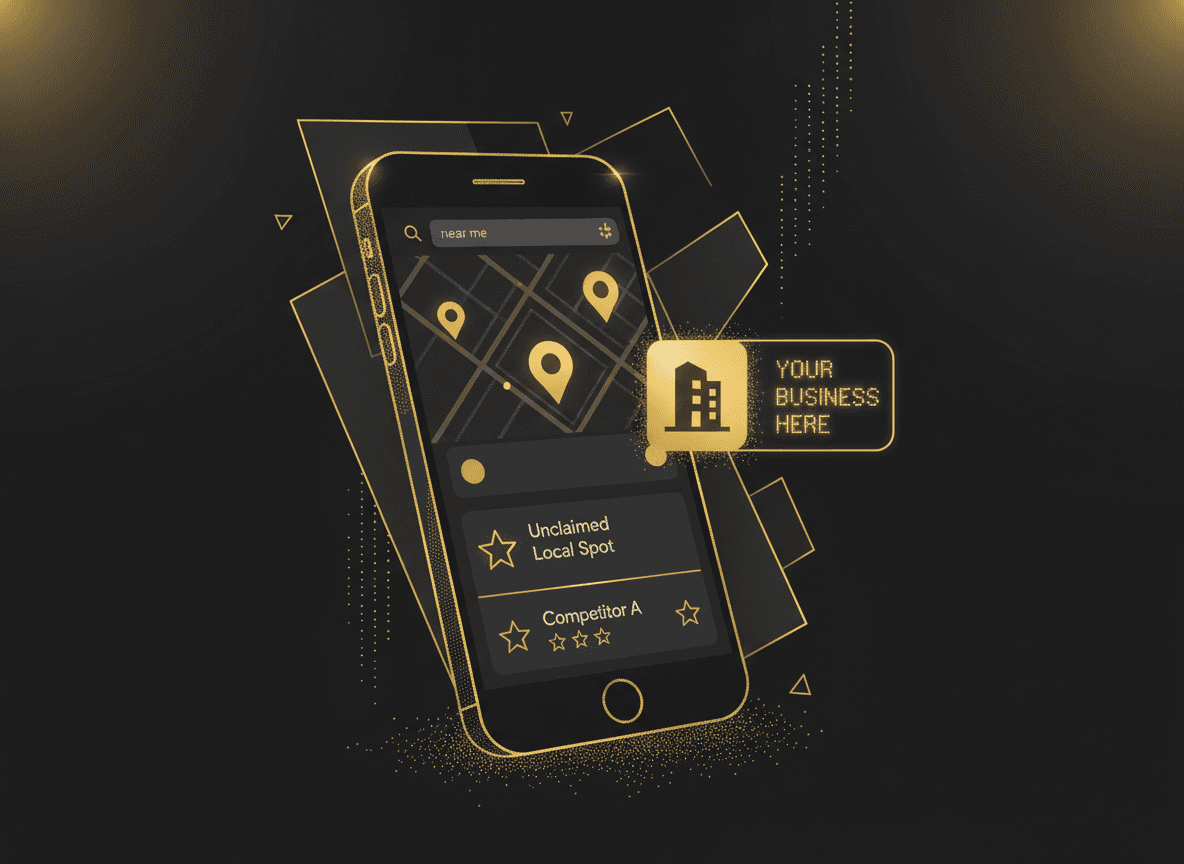
Every step of that assumes the business exists on Google Maps. No profile, no map pack. No map pack, no "near me" clicks. No clicks, no calls.
Here's an illustrative example to make it concrete: a home services company doing $40k/mo on referrals could plausibly be leaving another $10k–$20k/mo on the table simply because they're invisible to everyone who didn't get referred. (That's a hypothetical to show the shape of the leak — not a client result.) Same trade. Same city. Same skill. The only difference is one guy is on the map and one guy isn't.
This is the single most expensive mistake an operating business can make — because you already have the capacity to serve these customers. You're just never being seen by them.
Go to google.com/business. Search your business name. Two things happen:

Enter your exact business name, category, address (or service area if you go to customers), and phone number. Use the same name, address, and phone that appear on your website and everywhere else online. Google cross-checks this. Inconsistency kills rankings.
Google needs to confirm you're real. Depending on your business type, verification comes by postcard, phone, email, or video.
The postcard takes 5–14 days and lands with a code you enter to unlock the profile. Video verification means recording a quick walkthrough proving you operate at the location.
This is the step where owners get busy, lose the postcard, and abandon the whole thing. Don't. An unverified profile ranks nowhere. Set a reminder. Finish it.
Here's where most businesses do the bare minimum and wonder why nothing happens. A skeleton profile ranks like a skeleton. Fill everything:
Do all of this and you've gone from invisible to competitive in the map pack.
Here's the part nobody tells you. Getting on the map is the entry ticket, not the win.
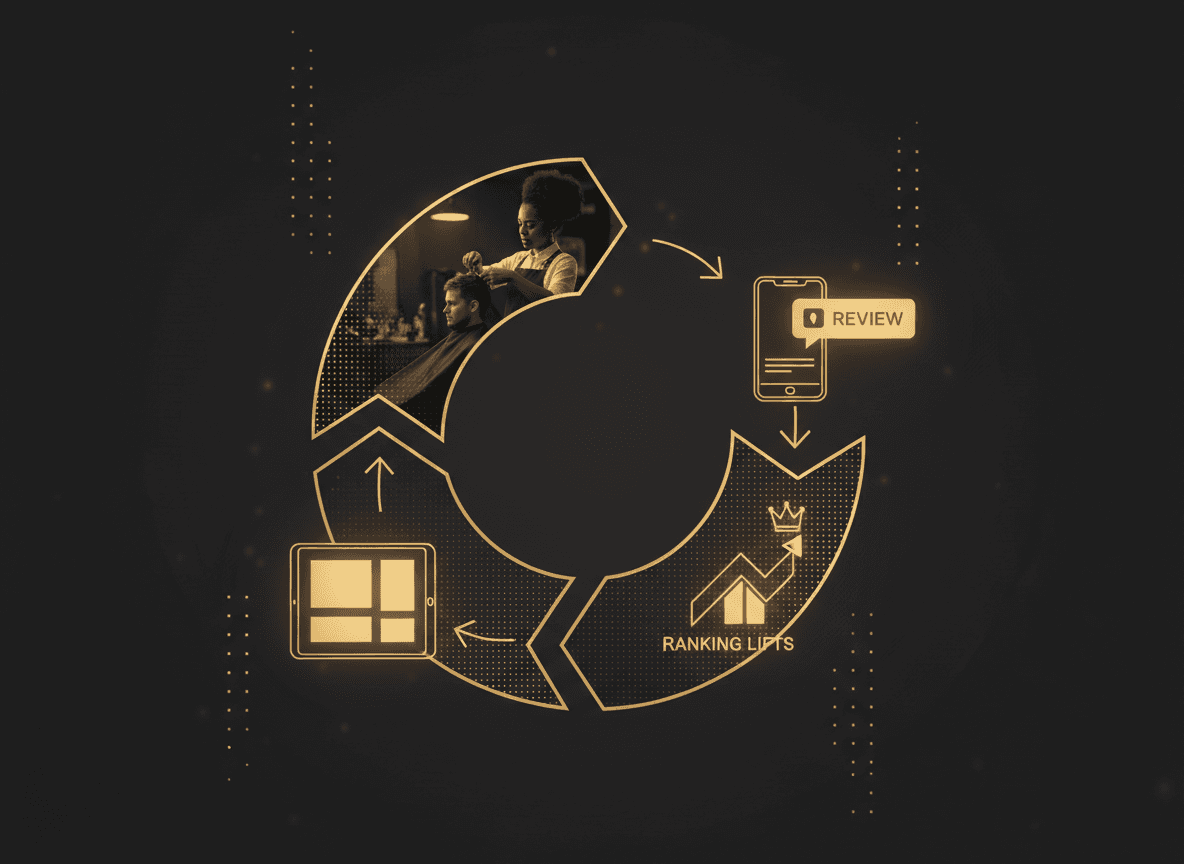
Google ranks the map pack heavily on reviews — quantity, recency, and rating. And customers choose based on those same reviews. Picture two shops side by side: one with a handful of old reviews, one with hundreds of fresh ones. Even if the first is the better operator, the review-heavy profile tends to win the click. Reviews compound.
So you need a system that:
A listing with no booking system is a billboard with no phone number. A listing with no review system stays stuck at the bottom of the pack. The profile is the front door. The booking and review engine behind it is what actually converts strangers into paying customers on repeat.
Most owners build the door and skip the engine. Then they conclude "Google Maps doesn't work." It works. Their setup doesn't.
Go claim your profile today — it's free and it's the highest-ROI 30 minutes you'll spend this month. Then ask the harder question: once you're visible, is anything behind the door built to convert?
That's the piece we build. If you want to see exactly where you're leaking bookings — from Maps visibility to booking flow to review generation — run your free Revenue Code Diagnostic at /diagnostic. It maps your biggest local-search revenue leak in a few minutes.
Ready to build the engine behind the door? Book a pricing call, or read more breakdowns like this on the blog.
Most SaaS founders treat the free trial as a waiting room. The ones converting at 25% or higher treat it as a structured sales system. Here is how to build that system.
Read moreA product roadmap tells you what you are building. A revenue engine tells you whether it is making money. Most SaaS founders only have one of these, and it is the wrong one.
Read more