Blog - The latest articles and news
Stay up-to-date with the latest industry news as our marketing teams finds new ways to re-purpose old CSS tricks articles.
Stay up-to-date with the latest industry news as our marketing teams finds new ways to re-purpose old CSS tricks articles.
by Kingdom Kode Team, Digital Innovation

Here's a question worth money: when someone in your city types "best [your service] near me" into ChatGPT or Google's AI Overview, does your business get named — or does a competitor? Knowing how to get your business found by AI search is no longer a 2027 problem. It's happening in your market right now, quietly, while most owners obsess over blue-link SEO that fewer people click every month.
If you don't know the answer to that question, you're already losing revenue you can't see.
This is the new invisible revenue gap. And the businesses that close it in the next 12 months will eat the ones that don't.
People don't scroll ten blue links anymore. They ask.

They ask ChatGPT which contractor to hire. They ask Perplexity for the best local med spa. They read Google's AI Overview and never scroll to your website at all.
That changes everything. Old search sent you a visitor who decided for themselves. New search sends an answer — and the AI decided for them. If the AI didn't mention you, you never existed in that conversation.
Think about what that means. Picture a hypothetical barbershop doing roughly $30k/mo that built its whole reputation on word of mouth and a Google profile. Now the "word of mouth" is a language model that scraped the web, and it recommends three shops. Guess which shops get the walk-ins? The three the machine can actually read.
You're not competing on quality. You're competing on legibility to the machine.
Here's the part nobody explains in plain English.

AI search engines don't "experience" your beautiful website. They don't see your hero video or your slick animations. They parse text, structure, and signals. If your site is a pretty box with no machine-readable labels, the AI shrugs and moves to the next business that made itself easy to understand.
Three things determine whether you're readable:
Miss all three and you're a blank spot on the map the AI is drawing.
You may have heard of robots.txt — the little file that tells Google's crawler where it can go. llms.txt (sometimes written llm.txt) is the same idea for the AI era.
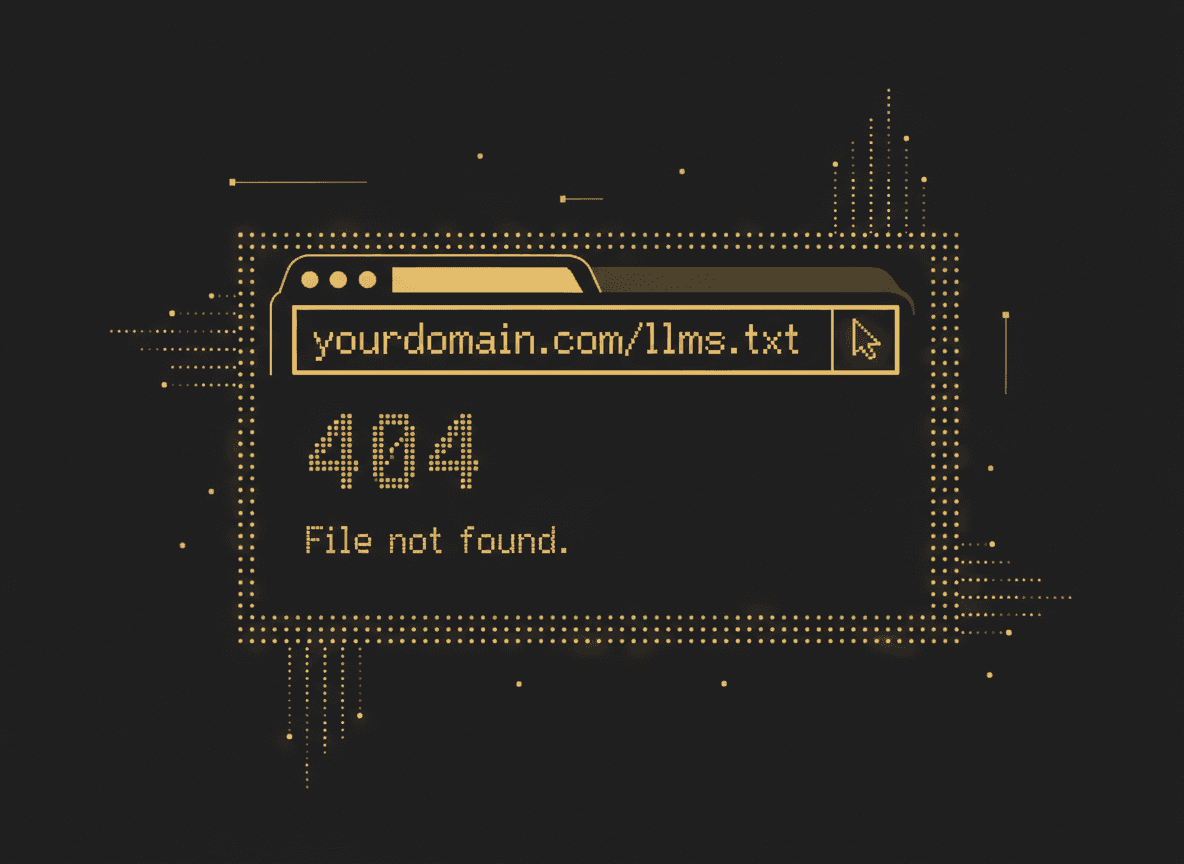
It's a simple text file at the root of your site that says, in language a model can digest: here's who we are, here's what we sell, here's our service area, here are the pages that matter, here's how to describe us.
Think of it as handing the AI a one-page cheat sheet instead of making it guess from your homepage carousel. When ChatGPT or Perplexity pulls context about your business, a clean llms.txt makes you the easy, confident answer.
Most SMBs have never heard of it. That's exactly why it's an edge — for now.
Schema is structured code you add behind the scenes. To a human, your page says "Open 9–5, $50 haircuts, 200 five-star reviews." To a machine without schema, that's just a wall of pixels.
Schema translates it: this is a LocalBusiness, this is the price, these are the hours, this is the rating, this is the location.
When an AI answers "cheapest oil change open on Sunday in Tampa," it's pulling from businesses whose schema literally spelled out price, day, and city. No schema, no answer. You could be the best and cheapest in town and still lose because you never labeled it.
Strip everything else away and AI search is trying to answer three questions to recommend you:
If a stranger can't answer those in ten seconds reading your site, neither can a language model. Vague taglines like "We deliver excellence" are poison here. Specificity wins: "Emergency plumbing in Austin, on-site in 60 minutes, flat-rate pricing." That's a sentence an AI can repeat back to a customer.
Clean metadata — your titles, descriptions, and on-page copy — is where you feed those answers in plain, direct language.
Run the math on your own business. Say — purely as a thought experiment — even 15% of your future customers start their search by asking an AI instead of scrolling, and you're invisible to that AI. You just lost 15% of your top-of-funnel without a single visible symptom. No drop in your rankings dashboard. No angry email. Just a slow leak.
That's what makes this dangerous. The gap doesn't announce itself. Your competitor who fixed their structured data isn't beating you in a fight you can watch — they're being recommended in rooms you'll never enter.
The good news: almost nobody in your local market has done this yet. Fix it now and you become the default answer before the pack wakes up.
Do this before you spend a dollar:
yourdomain.com/llms.txt in a browser. Blank or error? You don't have one.If that little test made your stomach drop — good. That discomfort is the revenue gap becoming visible.
Diagnosing this is free. I just gave you the framework. Building it — the llms.txt, the schema, the metadata that makes you the AI's default recommendation — is the part Kingdom Kode handles so you future-proof your discoverability while the competition sleeps.
Start by seeing exactly where you're leaking. Run your free Revenue Code Diagnostic and we'll show you what AI search sees when it looks at your business today — and what it should see instead.
Want more breakdowns like this? Read the rest of the blog, or reach out directly if you already know you're behind and want to move.
Most SaaS founders treat the free trial as a waiting room. The ones converting at 25% or higher treat it as a structured sales system. Here is how to build that system.
Read moreA product roadmap tells you what you are building. A revenue engine tells you whether it is making money. Most SaaS founders only have one of these, and it is the wrong one.
Read more