Blog - The latest articles and news
Stay up-to-date with the latest industry news as our marketing teams finds new ways to re-purpose old CSS tricks articles.
Stay up-to-date with the latest industry news as our marketing teams finds new ways to re-purpose old CSS tricks articles.
by Kingdom Kode Team, Digital Innovation
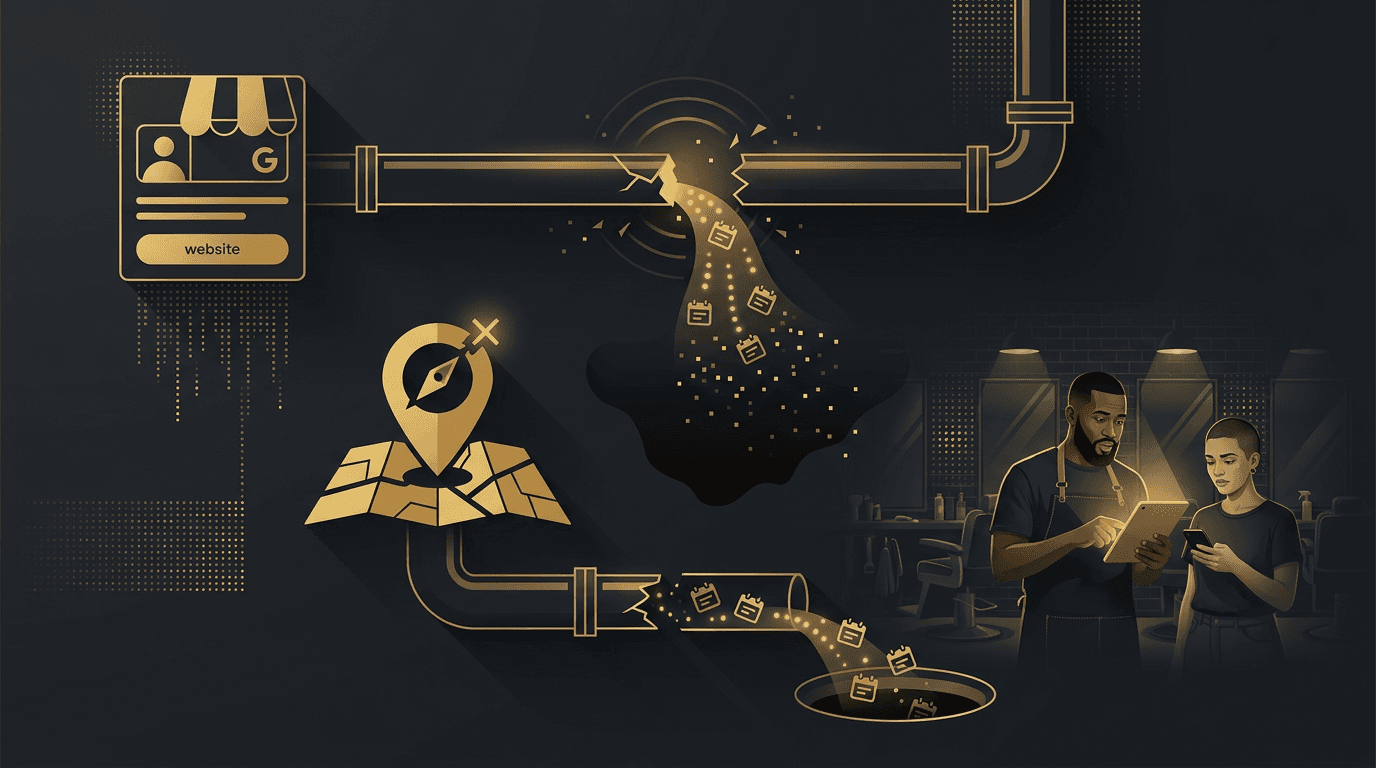
Your Google Business Profile looks great. Five stars. Good photos. Dozens of reviews. And it's still bleeding customers — usually because of a Google Business Profile wrong website link or a location that drops people at the wrong pin.
Both are silent. Neither shows up in your revenue reports. But both intercept the exact person who was ready to buy — the one who typed your service, saw your profile, and reached for their wallet.
That's the most expensive customer to lose. They already decided. You just made the last step hard.
Let's tear down the two leaks and give you the audit to close them today.
When someone finds you on Google and taps "Website," they're not browsing. They're buying. They want to book, call, or check your prices — now.
And most profiles send them to the wrong page.
The usual suspects:
Think about the sequence. Customer searches "barber near me." Sees your profile. Taps Website. Expects to book. Gets a homepage carousel and a hamburger menu. Every one of those friction steps costs you people who would have paid.
The fix isn't complicated. The website link on your GBP should point to the single page where a stranger can complete an action in under 15 seconds. Booking page. Not homepage. (We break down what that page should look like in our other articles.)
The website link handles people who tap through. The map pin handles people who drive.
And this one's worse, because when the pin is wrong, you don't just lose the click — you lose someone who got in their car.
Common location leaks:
Here's the compounding damage. Address inconsistency across your profile, website, and directories doesn't just misdirect drivers. It tends to weaken your local ranking, which shrinks how many people find you in the first place. You lose at the top of the funnel and the bottom at the same time.
You don't need fake statistics to see this. Do it with your own numbers.
Say you're a clinic doing $40k/mo, and your average appointment is worth $150. If your GBP drives, conservatively, 300 profile actions a month and even 10% of those hit a wrong-page or wrong-pin friction wall, that's 30 ready-to-buy people who slipped.
Capture even a third of them — 10 bookings — and that's $1,500/mo. $18,000 a year. From fixing two links.
The point isn't the exact figure. It's that the leak is happening at the most valuable moment in your entire funnel: after the customer already chose you. That's why it's the cheapest revenue you'll ever recover.
Open your profile on your phone right now — the way a customer sees it — and check:
Any "no" is a leak. Two or more "no" answers and you're losing bookings weekly.
Spot-fixing one link helps for a week. Then a directory falls out of sync, or you move, or someone edits the wrong field, and the leak reopens.
The durable fix is a unified setup: one consistent address and name across your profile, website, and directories, and a website link pointing straight to a fast booking flow — so the person who chose you can pay you without friction. This is the kind of system we build for operators.
That's the difference between a profile that looks good and one that converts. The looks-good version collects reviews. The converting version collects revenue.
Most owners have no idea their best customers are hitting a wall — because the profile looks perfect from the outside.
Run your free Revenue Code Diagnostic. We'll pinpoint where your profile, links, and booking flow are leaking ready-to-buy customers — and show you exactly what to fix first. Prefer to talk it through? Get in touch.
You already did the hard part: earning the click. Stop giving it away at the finish line.
Most SaaS founders treat the free trial as a waiting room. The ones converting at 25% or higher treat it as a structured sales system. Here is how to build that system.
Read moreA product roadmap tells you what you are building. A revenue engine tells you whether it is making money. Most SaaS founders only have one of these, and it is the wrong one.
Read more