Blog - The latest articles and news
Stay up-to-date with the latest industry news as our marketing teams finds new ways to re-purpose old CSS tricks articles.
Stay up-to-date with the latest industry news as our marketing teams finds new ways to re-purpose old CSS tricks articles.
by Kingdom Kode Team, Digital Innovation

Right now, somewhere in your practice management software, there's a list of people who love you, trust you, and owe you money for treatment they already agreed to. Overdue cleanings. Half-finished treatment plans. No-shows nobody chased. And your calendar has gaps in it this week. That's not a marketing problem — that's a dental patient recall system problem. You don't need more leads. You need to stop leaking the patients you already earned.
A hygiene chair sitting empty for an hour isn't neutral. It's negative. You're still paying the hygienist. Still paying rent. Still paying for the lights. The chair costs money whether or not a patient is in it — so an empty hour is pure loss, not "break even."

Most owners feel the gaps but never price them. Let's price them.
Say a hygiene appointment is worth $180 in production, and you've got 3 to 5 open hygiene slots leaking through the schedule every week. That's roughly $540 to $900 a week walking out the door. Call it $2,000–$4,000 a month in hygiene alone — before you count the restorative and treatment revenue that flows from those cleanings.
Now add the unbooked treatment plans. A patient accepts a $2,400 plan, does phase one, and never rebooks phase two because nobody followed up. How many of those are sitting in your system right now?
Every clinic sits on three piles of unclaimed revenue:

1. Overdue recall. Patients past their 6-month cleaning who never rebooked. They didn't leave. They just fell through the cracks.
2. Unscheduled treatment. Diagnosed and accepted work that never got a second appointment. This is the biggest pile and the most ignored.
3. Failed follow-ups. No-shows and cancellations that got one voicemail and then nothing. A no-show isn't a lost patient — it's an un-followed-up patient.
You already paid to acquire every one of these people. Reactivating them costs a fraction of what a new patient costs. This is the highest-ROI revenue in your entire practice, and it's the revenue nobody owns.
Here's the honest diagnosis: you probably have a "system" already. It's a person at the front desk with a printed list and instructions to "call when things are slow."
That fails every time. Not because your front desk is lazy — because they're buried. They're checking in patients, answering phones, handling billing, and calming down the guy in the waiting room. The recall list is always the thing that gets pushed to tomorrow. And tomorrow the list is longer.
Manual recall depends on a human having free time in a job that never has free time. That's why the chairs stay empty.
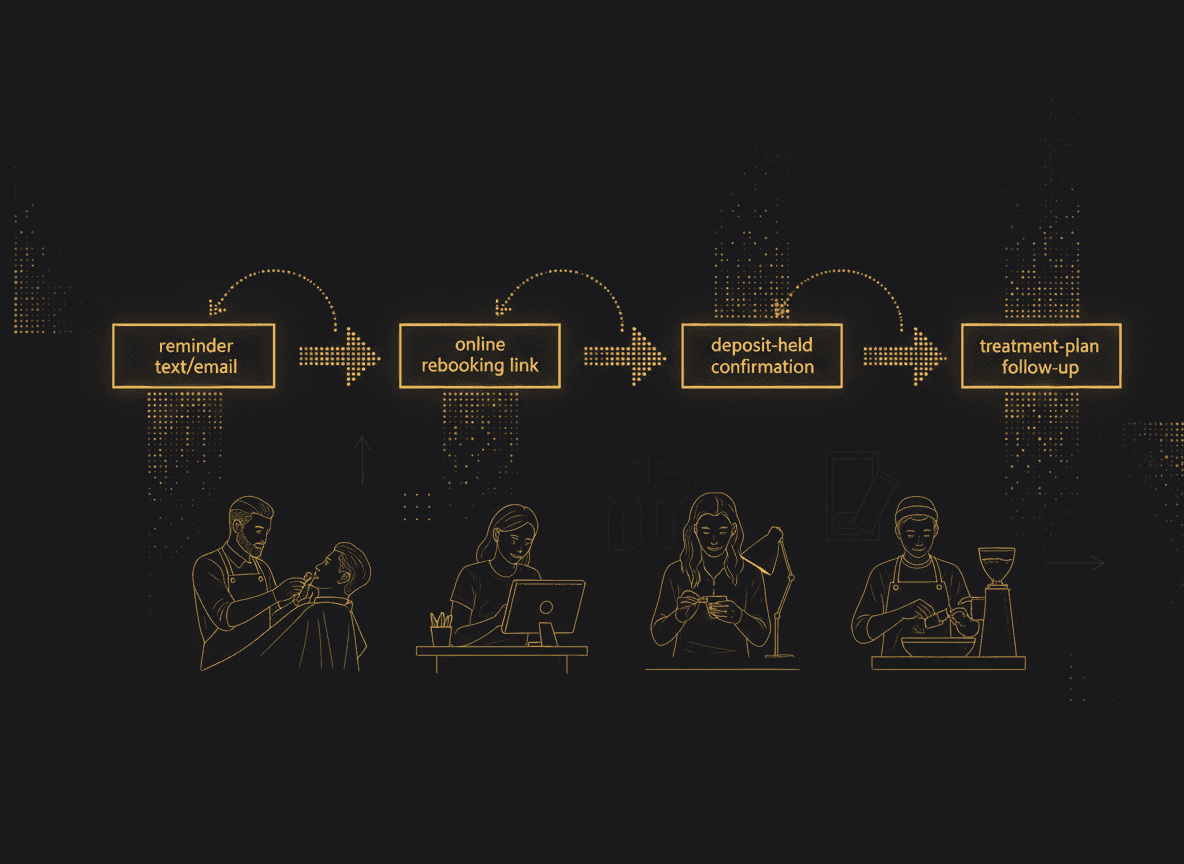
An automated dental patient recall system doesn't replace your team. It does the boring, repetitive chasing so your team does the human work. Four parts:
1. Automatic reminders on a schedule. The moment a patient hits their recall window, they get a text and email sequence — not one message, a sequence. Text tends to pull higher response than a phone call and doesn't require anyone to pick up the phone at all.
2. Online rebooking with one tap. The message contains a link to book. No phone tag. No "call us back during business hours." A patient re-books at 9pm from their couch and the slot fills itself. If they still have to call you, you've lost most of them.
3. Deposit-held appointments for high-value or repeat no-shows. For treatment appointments and chronic no-shows, hold the slot with a small deposit. A patient who's put money down has skin in the game and is far more likely to actually show. An empty deposit-held slot is also far cheaper to backfill than a free-cancel one.
4. Treatment-plan follow-up on autopilot. Accepted-but-unscheduled work triggers its own sequence: "Dr. Lee recommended X — let's get you booked." This is the pile everyone leaves on the table.
Stack those four and the gaps in the schedule start closing on their own.
Let's frame it plainly. Imagine a clinic reclaiming just 8 lapsed hygiene appointments a month at $180 — that's $1,440 in recovered hygiene, and the restorative work that follows those cleanings is usually worth multiples of that. Add two rescued treatment plans a month and you're into serious money.
Compare that to the cost of a system that runs 24/7, never gets busy, never forgets, and never takes a vacation. The empty chair loses money every day it stays empty. The system pays for itself and keeps paying.
This isn't about working harder. It's about plugging a leak you can't see because it never shows up as a bill — it shows up as an absence.
Before you buy anything, you should know exactly where your recall pipeline is bleeding — booking friction, weak reminders, no deposit protection, or reputation gaps scaring off rebookings.
Run your free Revenue Code Diagnostic and we'll show you where the empty-chair revenue is quietly slipping out of your practice — and what it's worth to close each gap.
Want to see how other clinics tightened this up? Browse more articles or get in touch.
Most SaaS founders treat the free trial as a waiting room. The ones converting at 25% or higher treat it as a structured sales system. Here is how to build that system.
Read moreA product roadmap tells you what you are building. A revenue engine tells you whether it is making money. Most SaaS founders only have one of these, and it is the wrong one.
Read more